

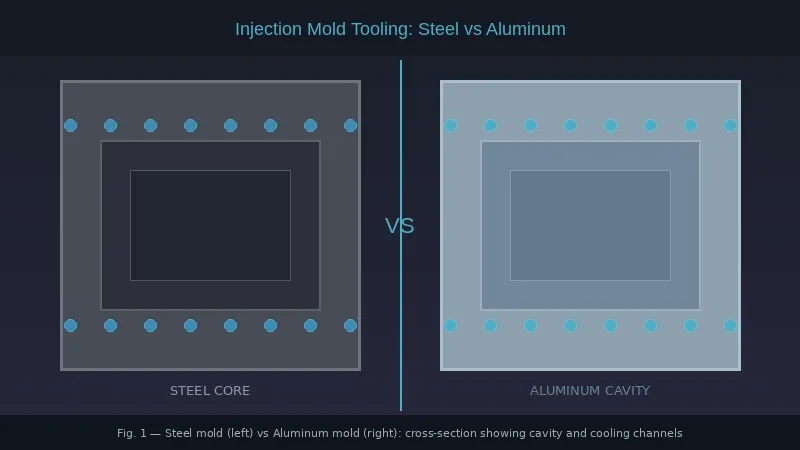
Fig. 1 — Steel mold (left) vs Aluminum mold (right): cross-section showing cavity geometry and cooling channels
There is no universally “best” mold material — only the one that fits your production phase, volume, and timeline. This guide compares aluminum and steel injection molds across seven critical dimensions so you can make a confident, data-driven decision.
Roughly 80% of plastic parts are manufactured via injection molding. The mold is the single most important capital investment in any molding project — it directly determines tooling cost, first-part lead time, unit economics at scale, and the surface quality of every part produced for the life of the tool.
1. Why Mold Material Is a Strategic Decision
For decades, hardened steel was the only serious option for injection mold tooling. As CNC machining centers matured and high-grade aluminum alloys like 7075 became widely available, aluminum molds emerged as a legitimate strategic choice — not a compromise, but a deliberate match for specific production phases.
Choosing between aluminum and steel is fundamentally about matching the mold to your production stage. Get it wrong and you either overpay for a steel tool you don’t need yet, or burn through an aluminum mold trying to run volumes it was never designed for.
Aluminum Mold — Key Advantages
✔ 30–50% lower upfront tooling cost vs. equivalent steel mold
✔ 10–15 day lead time (vs. 2–5 months for hardened steel)
✔ Thermal conductivity ≈5× higher — faster, more uniform part cooling
✔ Approximately 1/3 the weight of an equivalent steel mold
✔ Easy to modify — lower cost and faster turnaround on design changes
✔ Fewer defects: uniform cooling reduces sink marks, warpage, and voids
✔ Ideal for prototyping, bridge production, and early market validation
Steel Mold — Key Advantages
✔ Millions of production cycles without significant degradation
✔ Compatible with abrasive, high-temperature, and corrosive resins
✔ Superior long-term dimensional stability for tight-tolerance parts
✔ Lowest cost-per-part at high production volumes (100,000+ runs)
✔ Required for medical, aerospace, and automotive-grade applications
✔ Better suited for complex geometries: undercuts, thin walls, fine features
✔ Shorter per-shot cycle time at large-scale production volumes
2. Tooling Cost & Lead Time
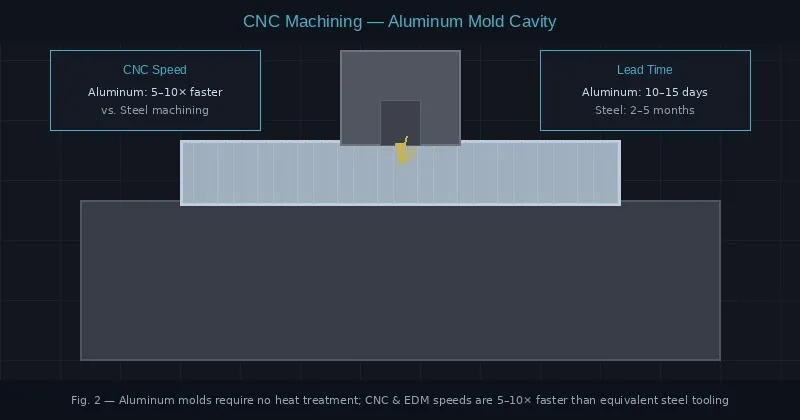
Fig. 2 — CNC machining of an aluminum mold cavity: 5–10× faster than steel, no heat treatment required
Aluminum’s machinability is its biggest commercial advantage. CNC feed rates and EDM speeds run 5–10× faster than with steel. No heat treatment is required. An average aluminum cavity is ready in 10 to 15 days.
Steel mold manufacturing is far more involved: harder material means slower cutting, accelerated tooling wear, and multiple heat-treatment cycles to achieve the required hardness. A hardened steel production mold typically takes 2 to 5 months from design sign-off to first shot.
In dollar terms, aluminum tooling typically costs 30–50% less than an equivalent steel mold. Beyond price, the lead time advantage is often the deciding factor: in a competitive market, getting to first production shot in two weeks versus five months can determine whether you capture or miss a critical launch window.
3. Mold Lifespan & Durability
Steel’s durability advantage is unambiguous. Under proper maintenance, a hardened steel mold reliably produces millions of parts — often over multiple decades. Common tool steel grades (H13, S7, P20) are rated for 500,000 to over 1,000,000 cycles.
Aluminum molds wear faster. The softer material is vulnerable to scratching even during routine maintenance operations. Industry consensus places aluminum mold lifespan at 10,000–50,000 cycles for standard alloys, with premium 7075 reaching up to 100,000 cycles in low-abrasion applications.
For a project targeting 1 million parts per year, aluminum is a poor long-run investment — you would need to replace it many times over, erasing any upfront savings. But for a product launch targeting 20,000 parts to validate market fit before committing to full production tooling, aluminum delivers exactly the right economics.
Aluminum molds are not a downgrade from steel — they are a different instrument for a different phase of the product lifecycle. The most efficient manufacturers use aluminum to move fast and validate demand, then switch to steel to scale profitably.
4. Part Quality & Surface Finish
Dimensional accuracy is comparable between the two materials under standard conditions — both achieve IT6 tolerance class using CNC and EDM processes. The difference emerges at extremes: complex geometries with tight shut-offs and thin walls favor hardened steel over the long run, as aluminum cavities can deform under sustained high-pressure cycles.
For surface finish, aluminum molds can be polished close to SPI Grade #A2. With electroless nickel coating, aluminum can meet optical-grade A-level surface requirements — suitable for transparent polycarbonate lenses, light pipes, and precision optical components.
Aluminum’s thermal advantage also improves part quality: faster, more uniform cooling reduces sink marks, warpage, voids, and burn marks. Scrap rates in aluminum-tooled early production runs are often lower than in steel, particularly while process parameters are being dialed in.
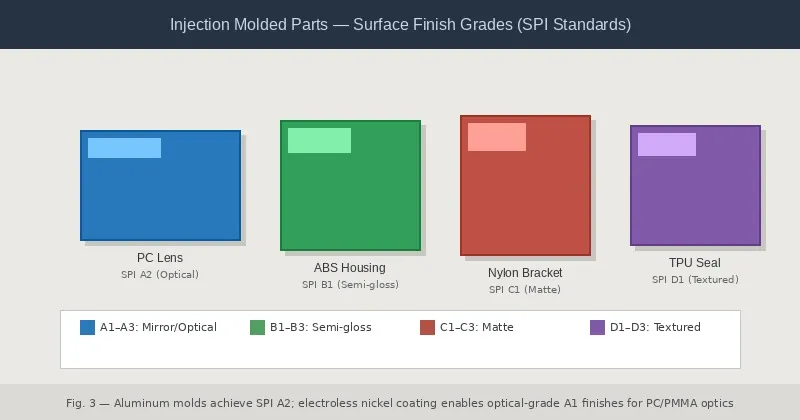
Fig. 3 — SPI surface finish grades achievable in injection molding. Aluminum molds reach A2; electroless nickel coating enables optical A1 for PC and PMMA optics
5. Resin Compatibility
Aluminum molds are compatible with most commodity and engineering resins: PP, PE, ABS, PC, Nylon, TPU, and similar materials. They perform particularly well with optically transparent grades (PC, PMMA) where uniform thermal distribution is critical for optical clarity.
Steel becomes the only viable option when using:
• Glass- or fiber-filled resins (e.g., 30% GF Nylon, glass-filled PBT) — abrasive fillers rapidly erode aluminum cavities, causing premature mold failure
• High-temperature engineering resins such as PEEK, Ultem (PEI), and PPS — require injection temperatures beyond aluminum’s safe processing range
• Corrosive or chemically aggressive resins (e.g., PVC, certain flame-retardant grades) — attack and pit aluminum surfaces over repeated cycles
• Highly abrasive compounds containing mineral fillers, metallic pigments, or carbon fiber reinforcement
If your resin falls into any of these categories, steel is not a preference — it is mandatory.
6. Full Comparison: Aluminum vs Steel
Factor | Aluminum Mold | Steel Mold |
Tooling Cost | 30–50% lower upfront | Higher initial investment |
Lead Time | 10–15 days | 2–5 months |
Mold Lifespan | 10,000–100,000 cycles | 500,000–1,000,000+ cycles |
Thermal Conductivity | ~235 W/m·K (≈5× steel) | ~45 W/m·K |
Injection Cycle Time | 44–70 seconds | 5–10 seconds |
Design Modification | Easy — low cost | Difficult — expensive |
Resin Compatibility | Commodity & engineering | All resins incl. abrasives |
Optimal Production Volume | 100 – 50,000 parts | 100,000+ parts |
Mold Weight | ~1/3 of steel equivalent | Standard (heavier) |
Cost Per Part (High Vol.) | Higher | Lowest at scale |
Surface Finish | Up to SPI A2 (Ni-coated) | Full SPI A1–D3 range |
Best For | Prototyping, bridge runs | Mass production |
7. How to Choose: A Practical Decision Framework
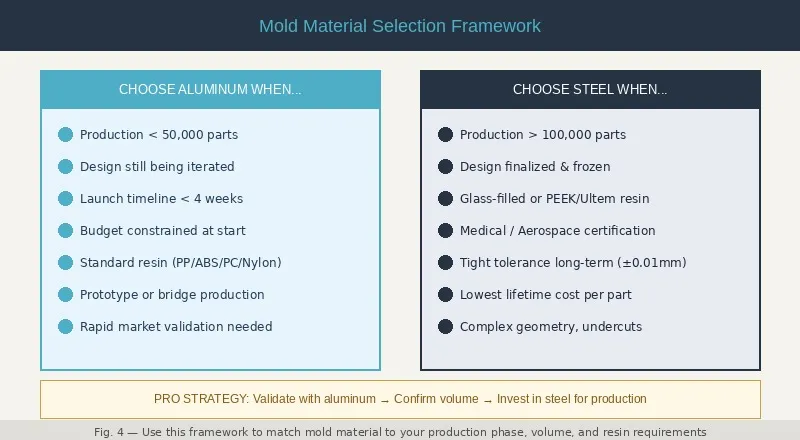
Fig. 4 — Decision framework: match mold material to your production volume, timeline, resin type, and design maturity
The right choice depends entirely on where you are in your product’s lifecycle. Four questions cut through the complexity:
1. What is your expected production volume? Under 50,000 parts — aluminum is almost always the right call. Over 100,000 parts with a long production horizon, steel’s lifetime economics win decisively.
2. Is your design finalized? If you’re still iterating, aluminum’s low modification cost makes design changes far cheaper and faster. Once the design is locked, commit to a steel production tool.
3. What resin will you use? Glass-filled, high-temperature, or corrosive resins require steel without exception. Standard commodity or engineering resins are suitable for either material.
4. How tight is your time-to-market window? Aluminum’s 2-week lead time frequently creates more commercial value than the tooling cost delta it saves. Time is a cost center too.
Pro strategy: Validate with aluminum → Confirm volume commitment → Invest in steel for production. This two-phase approach minimizes early risk and keeps upfront capital lean while securing optimal unit economics at scale.
Conclusion
Aluminum and steel molds are not rivals — they are complements for different stages of the product lifecycle. Aluminum delivers speed, flexibility, and lower upfront investment, making it the right tool for prototyping, bridge runs, and early market validation. Steel delivers longevity, dimensional precision, and the lowest lifetime cost-per-part, making it the right choice for established, high-volume production. The optimal approach combines both: validate with aluminum, scale with steel. Evaluate production volume, part complexity, resin requirements, and your time-to-market pressure before committing — those four factors will always point you to the right answer.
Copyright 2026(C) HUAWEI PRODUCT DEVELOPMENT INDUSTRIAL LTD (2009-2024)
All Rights Reserved
marketing@prototypeinjectionmold.com
Contact Information :
Byron Wang
Phone: +86- 86-755-8238-2595
Mobile: +86-139-2383-5403
Email: marketing@prototypeinjectionmold.com
HPDI (HUAWEI PRODUCT DEVELOPMENT INDUSTRIAL LTD)
Address:Building 3, Puxia Industrial Zone, Liuyue, Henggang St., Longgang District, Shenzhen., China