

Low-Volume Injection Molding: Costs, Quantities & Tooling
Introduction
Not every plastic product needs a multi-cavity mold designed for millions of cycles. Startups may need a limited launch quantity, manufacturers may require replacement parts, and engineering teams may need several hundred production-grade components for validation. In these situations, low volume injection molding can deliver consistent molded parts without the full investment required for large-scale tooling.
The process uses a mold designed around a controlled quantity, expected life, material, and quality requirement. Simplifying nonessential features helps balance tooling cost, lead time, and part performance.
1. What Counts as Low Volume?
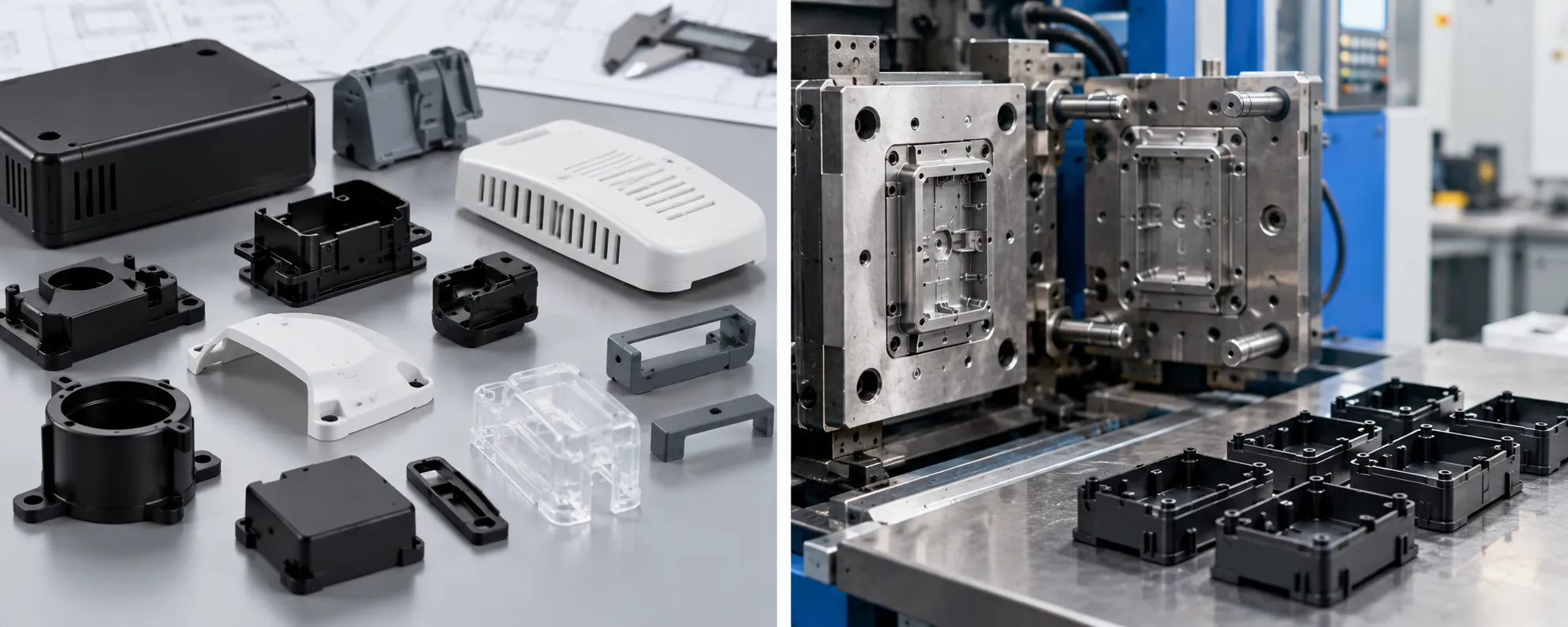
There is no universal quantity that defines low volume injection molding. A practical range may begin with a few dozen parts and extend to several thousand, depending on part size, resin, complexity, cycle time, and alternative-process cost.
For a small electronic cover, 5,000 pieces may still be a short run. For a large automotive component, a few hundred may represent a substantial program. The decision should be based on total project economics rather than a fixed quantity label.
2. Common Reasons to Choose Small Batch Injection Molding
Small batch injection molding is commonly used for pilot production, customer trials, limited launches, certification samples, customized equipment, service parts, and temporary supply while a production mold is built.
It is also useful when demand is uncertain. A company can produce an initial batch, collect feedback, and improve the product instead of investing immediately in high-output tooling and inventory.
3. Tooling Strategies for Lower Quantities
A low-volume mold may use one cavity, a standard mold base, pre-hardened steel or aluminum inserts, manual loading, simplified cooling, and cold-runner gating. These choices lower initial investment but must still support the required resin, dimensions, appearance, and mold life.
Aluminum suits easy-to-machine tools and lower quantities. Steel is often better for glass-filled materials, demanding textures, precision shutoffs, or longer programs. Replaceable inserts can help when related products share a common structure.
4. Main Low Volume Injection Molding Cost Drivers
Low volume injection molding cost includes more than the mold price. Main factors include geometry, tool material, side actions, finish, tolerance, resin, quantity, machine size, cycle time, inspection, secondary operations, packaging, and shipping.
Multiple undercuts, thin sealing walls, high-polish surfaces, or a large projected area may require a more complex mold and larger press. A design with consistent walls, draft, accessible gates, and practical tolerances reduces tooling and processing cost. The most economical design is usually the one that molds repeatedly with minimal adjustment.
5. Comparing Production Methods
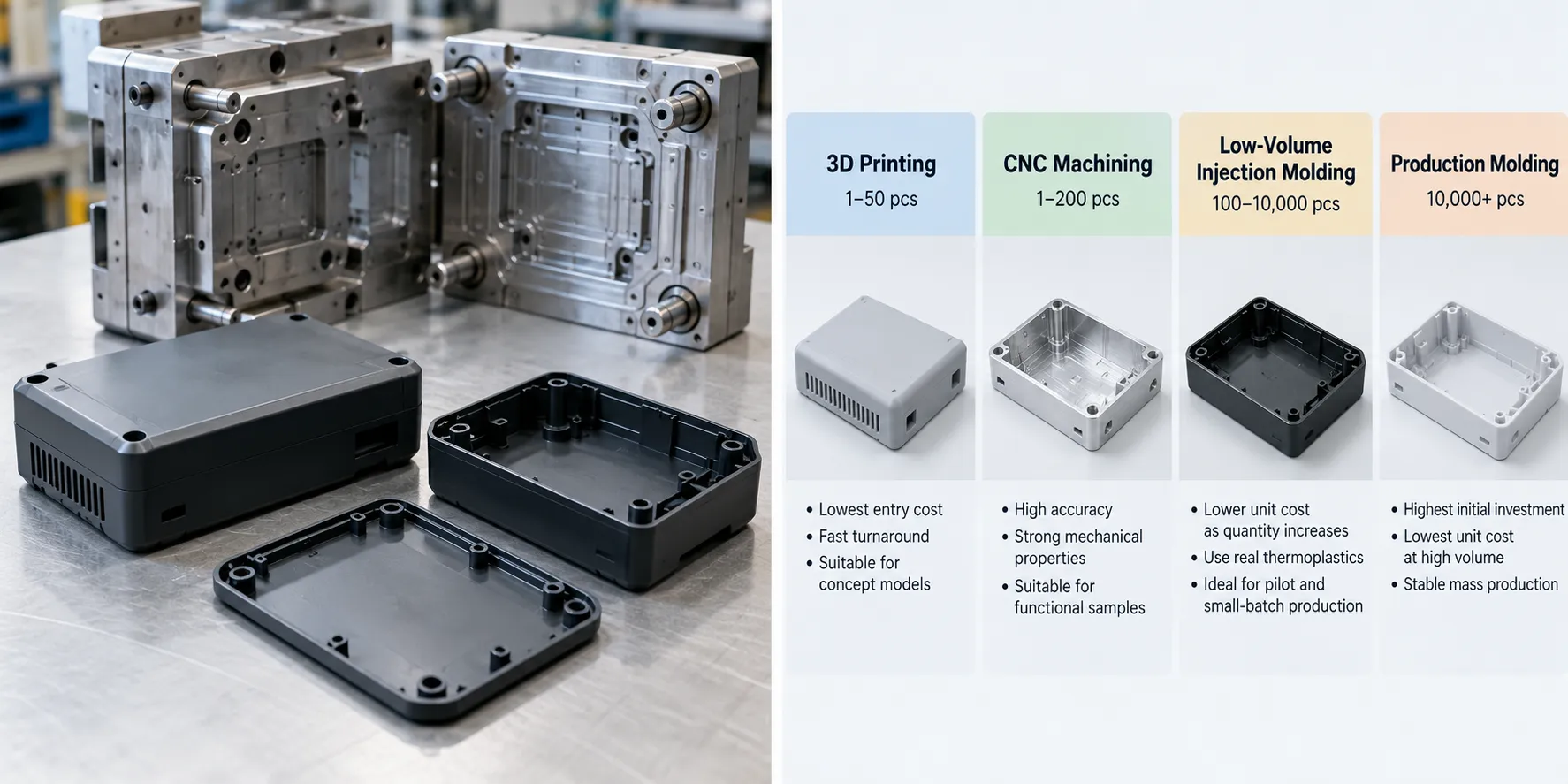
For a few concept models, 3D printing normally has the lowest entry cost. CNC machining provides accurate functional samples but becomes expensive when every part needs substantial machining. Vacuum casting supports small cosmetic batches, usually in substitute polyurethane.
Low volume plastic injection molding requires an initial tool, but its unit cost improves as quantity grows and it can use the intended thermoplastic. A production mold has the highest initial investment but can deliver the lowest unit cost at stable high volume.
Production Method and Quantity Planning
| Method | Planning Quantity | Best Use |
|---|---|---|
| 3D printing | 1–50 | Concept models |
| CNC machining | 1–200 | Functional samples |
| Low-volume molding | 100–10,000 | Pilot and small-batch production |
| Production molding | 10,000+ | Stable high-volume demand |
Quantities are indicative planning ranges, not fixed production thresholds. The most economical process depends on geometry, material, tolerance, and total project requirements.
6. Typical Quantity Decision
A requirement for 10 parts may remain with printing or CNC machining. At 100 to 1,000 functional parts, low quantity injection molding should be compared with machining and casting. At several thousand parts, molding becomes increasingly attractive when repeatability and production resin are required.
These figures are planning references only. A large complex part may justify tooling at a lower quantity, while a tiny simple part may remain economical with another process for longer.
7. How DFM Reduces Small-Run Cost
Design for manufacturability directly affects small volume injection molding. Uniform walls reduce sink and warpage, draft supports ejection, and proper rib and boss design avoids heavy sections. Early gate planning reduces cosmetic problems and weak weld lines.
DFM may also replace automatic slides with removable inserts for low quantities. Tight tolerances should be reserved for functional, sealing, or assembly features because unnecessary precision adds inspection and adjustment effort.
8. Planning for Future Growth
A low-volume tool should support the next stage. Document the approved resin, shrinkage, gate behavior, molding window, dimensions, cosmetic standard, and steel changes.
If demand grows, this information can support a production mold with more cavities, faster cooling, automation, and lower unit cost. The bridge tool may remain available for service parts or emergency supply.
9. Selecting a Low-Volume Supplier
Reliable low volume injection molding companies should combine DFM, mold design, toolmaking, molding, inspection, and responsive engineering communication. Confirm that the supplier can process the required resin, measure critical features, support mold changes, and maintain the tool for repeat orders.
HPDI provides prototype molds, bridge molds, molded prototypes, and low-volume production. Customers can review its services, case studies, facilities, and quotation FAQ before submitting project data.
Conclusion
Low volume injection molding provides a flexible route between one-off prototypes and high-volume production. It is valuable when a product needs production material, repeatable quality, pilot quantities, or a controlled market introduction.
The best solution matches the mold to the real quantity, resin, geometry, and business risk. With clear DFM and future planning, small batch injection molding can reduce investment while preserving molded-part performance.