

Prototype Injection Molding T1 Sample Inspection: Checklist and Approval Guide
Prototype injection molding is widely used to manufacture functional plastic parts for product development, engineering verification, and low-volume production. However, receiving the first molded samples does not automatically mean a component is ready for assembly or manufacturing.
Whether you are developing a single plastic component, using a simplified steel mold, or producing injection molding prototypes with aluminum tooling, proper T1 sample inspection is essential.
Problems such as dimensional variation, warpage, sink marks, weak snap-fits, and inconsistent molding conditions can affect the performance of otherwise acceptable-looking plastic parts.
This guide explains how to inspect T1 samples, identify potential defects, evaluate prototype tooling, and determine whether injection molded prototypes are ready for the next manufacturing stage.
1. What Is a T1 Sample in Prototype Injection Molding?
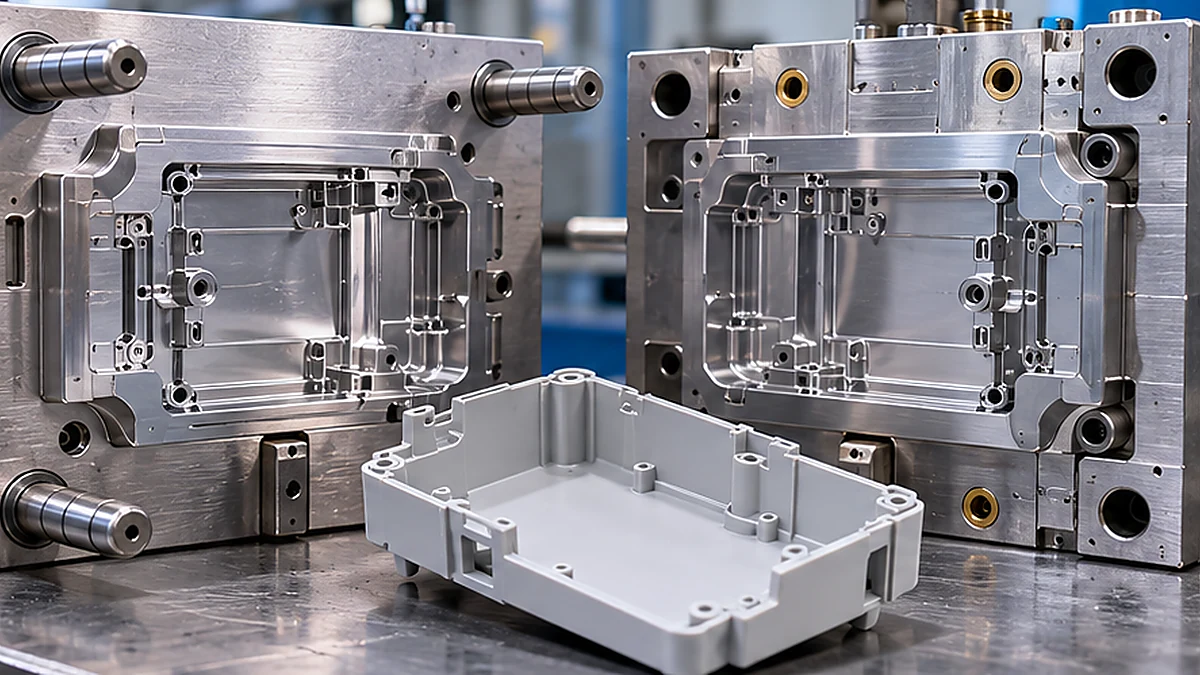
A T1 sample is a plastic component produced during an early formal injection mold trial, usually after the prototype mold has been manufactured and assembled.
Some manufacturers use T0 to describe an internal preliminary trial and T1 for the first customer-facing sampling round. Naming conventions can vary between mold shops.
During the T1 trial, engineers examine whether the mold can produce parts that meet the intended design specifications.
The evaluation typically includes:
Dimensional accuracy and tolerances
Material performance and resin compatibility
Surface appearance and molding defects
Assembly fit and mechanical functionality
Mold operation and part ejection
Process stability and repeatability
Unlike CNC-machined or 3D-printed prototypes, injection molding prototypes are manufactured using an actual molding process, often with the intended production resin.
This allows engineers to evaluate molding-related characteristics such as shrinkage, flow behavior, weld lines, and ejection performance.
Key takeaway: T1 samples provide engineering evidence for approving, correcting, or refining a prototype injection mold before further manufacturing.
2. Why T1 Inspection Matters for Prototype Injection Moulding
Prototype injection moulding, the British English spelling of prototype injection molding, is commonly used for product development and functional testing.
The process allows manufacturers to evaluate molded plastic parts before making a larger investment in production tooling.
For projects using aluminum or simplified steel molds, T1 inspection is especially valuable because the purpose of the tooling is often to support rapid design verification and controlled product iteration.
A successful T1 inspection can help manufacturers:
Identify product design problems before production
Verify critical part dimensions
Confirm assembly compatibility
Detect molding defects and tooling limitations
Determine whether mold modifications are necessary
Reduce the risk of repeated engineering changes
However, a sample that passes visual inspection may still have functional or dimensional problems.
For example, a plastic electronics enclosure may appear acceptable but have a slightly misaligned PCB mounting boss or connector opening.
Such problems can lead to assembly difficulties even when the external appearance is satisfactory.
A structured inspection process helps identify these issues early.
3. Choosing Between Aluminum and Simplified Steel Prototype Molds
The type of tooling used for injection molding prototypes can influence manufacturing cost, lead time, tool durability, and modification flexibility.
Two common options are aluminum prototype molds and simplified steel molds.
| Factor | Aluminum Prototype Mold | Simplified Steel Mold |
|---|---|---|
| Initial tooling cost | Often economical for suitable projects | Depends on mold complexity and steel selection |
| Manufacturing time | Can be shorter for suitable geometries | May require additional machining time |
| Modification flexibility | Suitable for selected design changes | Depends on insert and cavity construction |
| Wear resistance | Generally lower than hardened tool steel | Can offer greater wear resistance |
| Typical applications | Functional prototypes and limited production | Prototypes, pilot runs, and extended bridge production |
| Material compatibility | Requires review of resin and filler abrasiveness | More options for demanding materials |
The correct choice depends on product geometry, required tolerances, resin selection, expected quantity, and future production plans.
Can a Single Piece Injection Mold Be Used for Prototype Production?
The term single piece injection mold can be ambiguous.
For a project that requires only one molded plastic component per molding cycle, manufacturers may use a single-cavity injection mold .
A single-cavity mold produces one molded part per shot and can be suitable for certain prototype development and low-volume manufacturing projects.
However, a single-cavity mold is not necessarily manufactured as one solid piece. Conventional injection molds generally require separate mold halves and may also contain inserts, ejector pins, and other tooling components.
A simple mold intended for a single plastic component may be a practical option when:
The component has relatively straightforward geometry
The expected production quantity is limited
The product requires functional injection molded samples
Design modifications may still be necessary
A multi-cavity production mold is not yet justified
For complex products with undercuts, threaded features, or difficult release geometry, additional mold mechanisms may be necessary.
Therefore, a single-cavity tooling approach should be evaluated according to the actual part design rather than selected solely to reduce cost.
4. What Should Engineers Inspect on T1 Injection Molding Prototypes?
A complete T1 inspection should include dimensional, visual, material, and functional evaluations.
4.1 Dimensional Accuracy and Tolerances
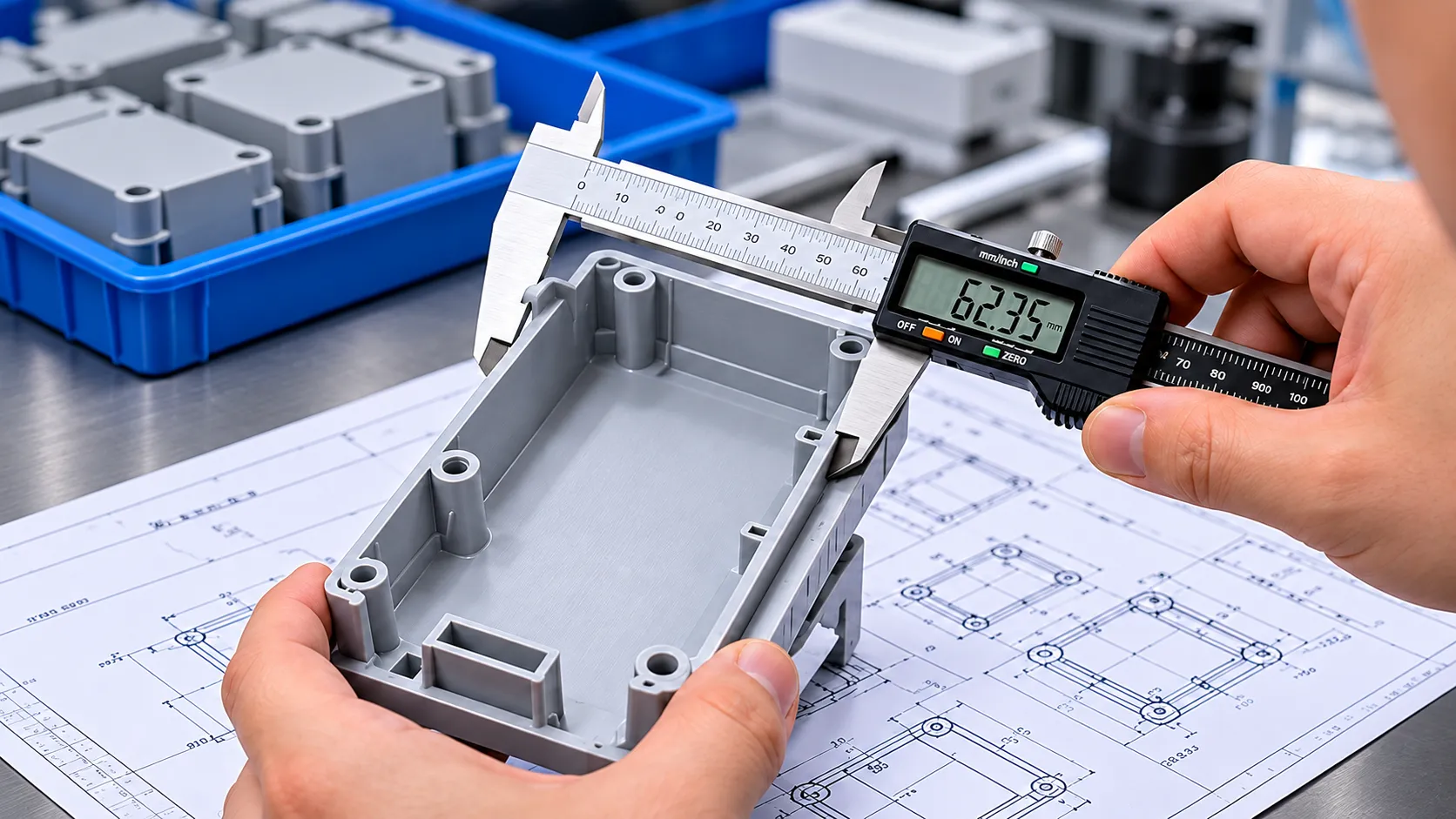
Dimensional inspection is one of the most important steps in approving injection molding prototypes.
The inspection should compare the molded components with the latest approved engineering drawings and CAD models.
Critical measurements may include:
Overall component dimensions
Hole diameters and mounting positions
Screw boss dimensions
Snap-fit geometry
Connector openings
Wall thickness at accessible locations
Flatness and alignment
Mating part clearance
Depending on the dimensional requirements, manufacturers may use digital calipers, micrometers, optical measurement systems, specialized gauges, or coordinate measuring machines.
Not every dimension requires the same inspection priority.
Features affecting assembly, fastening, sealing, or product functionality should receive particular attention.
Measurement methods and acceptance criteria should be agreed upon before the inspection.
For additional technical guidance, see our prototype injection mold tolerance guide .
4.2 Surface Appearance and Molding Defects
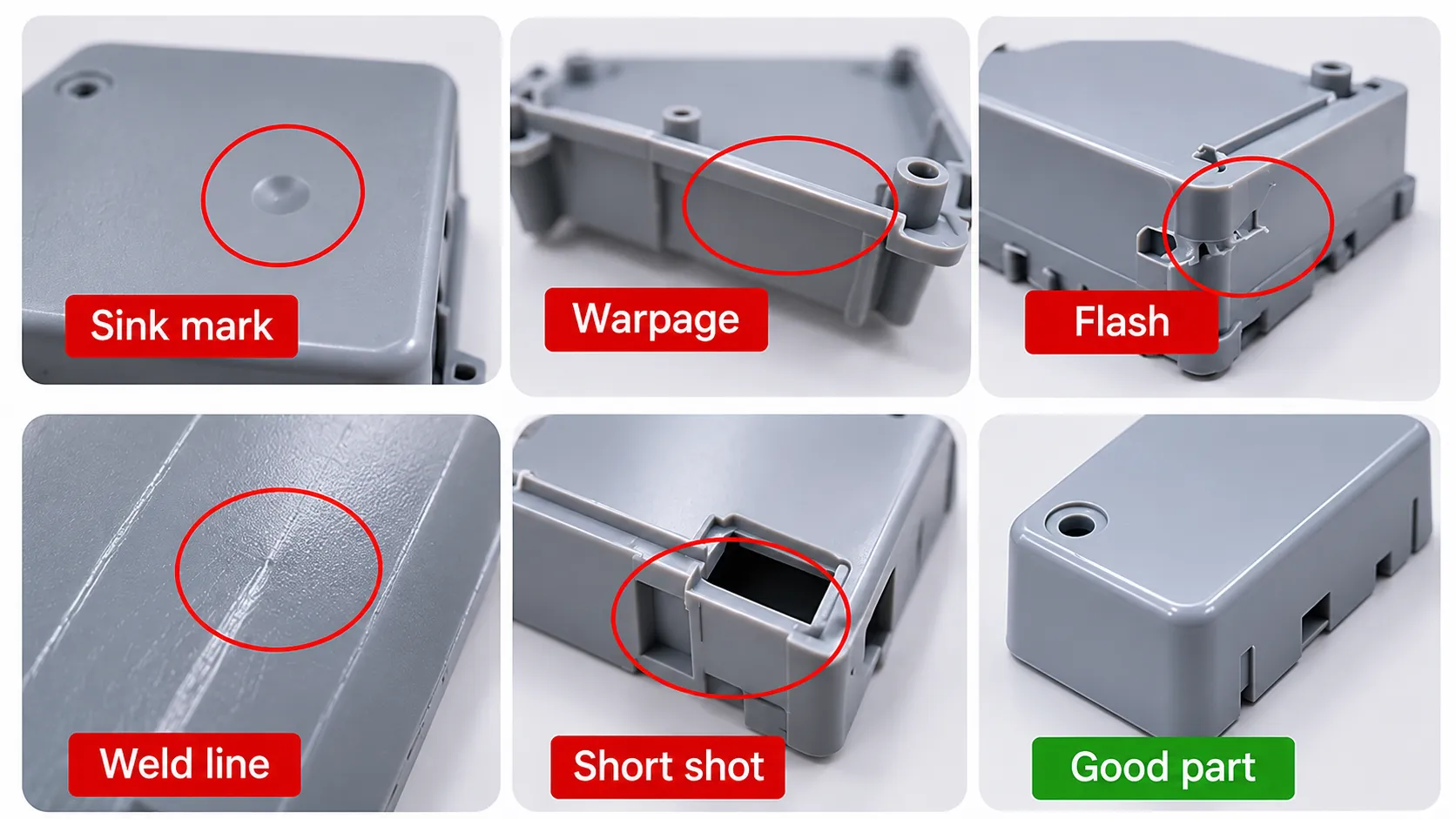
Even when prototype plastic parts meet dimensional requirements, visible molding defects may indicate problems with mold design, material behavior, or processing conditions.
Common defects include:
| Defect | Possible Cause | Recommended Evaluation |
|---|---|---|
| Sink marks | Thick sections or insufficient packing | Check ribs, bosses, and wall thickness |
| Warpage | Uneven cooling or shrinkage | Measure flatness and assembly fit |
| Short shots | Incomplete cavity filling | Inspect flow restrictions and venting |
| Flash | Mold shut-off gaps or excessive pressure | Check parting lines and shut-offs |
| Weld lines | Separate flow fronts meeting | Evaluate location and strength requirements |
| Burn marks | Trapped gases or overheating | Review venting and filling conditions |
| Ejector marks | Concentrated ejection force | Check ejector locations and deformation |
The severity of a defect depends on the component's function and cosmetic requirements.
For instance, a minor mark on a concealed internal surface may be acceptable, while a similar mark on a visible product housing could require corrective action.
4.3 Material and Resin Verification
One important advantage of prototype injection molding is the opportunity to produce functional samples using the intended thermoplastic material.
Common materials include:
ABS
Polycarbonate (PC)
Polypropylene (PP)
Polyoxymethylene (POM)
Nylon (PA)
Selected glass-fiber-reinforced thermoplastics
Material verification should include the resin grade, color, fillers, additives, and relevant processing requirements.
Different material grades may have different shrinkage behavior, stiffness, impact resistance, and thermal performance.
Using a substitute material without engineering approval can make the test results less representative of the final product.
4.4 Assembly and Functional Validation
Injection molding prototypes should be evaluated under conditions that reflect their intended application.
For plastic electronics housings, typical checks include PCB positioning, connector alignment, screw installation, and enclosure fit.
For mechanical components, testing may involve snap-fit engagement, load resistance, repeated assembly, or interaction with moving parts.
Important questions include:
Do the components assemble without excessive force?
Are screw bosses correctly positioned?
Do snap-fits engage and release as intended?
Are the intended clearances maintained?
Does the part deform during assembly?
Are all required functional features accessible?
A component that looks correct but cannot be assembled reliably should not be approved for production without further evaluation.
4.5 Shrinkage and Warpage
Thermoplastic materials shrink during cooling.
The final geometry can be influenced by wall thickness, gate location, packing pressure, cooling conditions, and material properties.
For thin-walled plastic housings, uneven shrinkage can result in distortion that affects mating surfaces.
Engineers should inspect the free-state geometry and, where specified, the assembled condition.
Repeated warpage problems may require modifications to the part design, mold cooling arrangement, gate location, or molding parameters.
4.6 Process Stability
A successful prototype mold trial should demonstrate more than the ability to produce one acceptable part.
Engineers should also evaluate whether the molding process can produce reasonably consistent results under suitable operating conditions.
Relevant trial information may include:
Injection speed and pressure
Melt and mold temperatures
Holding pressure and time
Cooling conditions
Cycle time
Sample weight consistency
Material preparation
Changes in defects during repeated molding
A small number of acceptable samples does not automatically establish long-term production capability.
The appropriate level of validation depends on the intended manufacturing stage and the risk associated with the product.
4.7 Prototype Mold Function
The tooling itself should also be inspected.
Common checkpoints include mold opening and closing, cavity filling, venting, ejection, cooling, and moving components.
For aluminum molds, engineers should review any areas subject to concentrated loading or premature wear.
For simplified steel molds, proper operation of inserts, slides, shut-offs, and ejector systems may be important.
The objective is to confirm that the prototype mold can support the intended next stage of manufacturing.
5. T1 Sample Approval Checklist
The following checklist can be used as a starting point for evaluating injection molding prototypes.
| Inspection Category | Acceptance Requirement |
|---|---|
| Design revision | Matches approved CAD files and engineering drawings |
| Material | Correct specified thermoplastic grade |
| Dimensions | Critical features meet agreed tolerances |
| Appearance | Meets specified cosmetic standards |
| Shrinkage and warpage | Does not compromise required geometry or function |
| Functional features | Clips, bosses, and mounting features operate correctly |
| Assembly fit | Components assemble according to design requirements |
| Molded defects | No unacceptable defects affecting function or appearance |
| Process repeatability | Sufficient consistency for the intended development stage |
| Mold operation | Tool operates without unresolved critical issues |
| Documentation | Findings and corrective actions are recorded |
The exact acceptance criteria should be defined for the individual project.
For critical components, additional inspections or formal qualification procedures may be necessary.
6. When Does a T1 Sample Require Mold Modification?
Not every issue found during T1 inspection requires a tooling change.
Some defects can be corrected through process optimization, while others require modification of the cavity, mold components, or part design.
Process Adjustments
For certain defects, engineers may evaluate changes to injection speed, packing pressure, melt temperature, mold temperature, or cooling conditions.
However, process changes should not simply hide an underlying design problem.
The final process must remain suitable and repeatable.
Tooling Modifications
Tooling changes may be required when problems originate from cavity geometry, inadequate venting, gate design, or ejection layout.
Possible corrections include:
Modifying cavity dimensions
Adjusting gate or vent locations
Reworking selected inserts
Improving ejection features
Correcting shut-off surfaces
Product Design Changes
Some problems are better addressed through a component design revision.
Examples include excessive wall thickness, insufficient draft, weak snap-fit geometry, or poorly positioned mounting bosses.
Before modifying a prototype injection mold, the engineering team should determine the root cause and assess the proposed correction.
This is particularly important when the mold is intended to support multiple design iterations or additional production batches.
7. How Many Injection Molding Prototypes Are Needed for T1 Inspection?
There is no universal T1 sample quantity for every project.
The appropriate quantity depends on the part's complexity, intended use, engineering risk, and customer-specific requirements.
For early product development, a limited number of samples may be sufficient to identify obvious molding and design issues.
For pilot production, engineers may need a more structured sampling plan to evaluate consistency across a stable molding run.
Important considerations include:
The number of critical dimensions
The number of mold cavities
The required functional tests
The likelihood and consequences of part failure
The intended production quantity
Customer-specific inspection requirements
When the mold contains multiple cavities, sample identification should allow results to be traced to each cavity.
For applications requiring formal process validation, the sampling strategy should follow the applicable customer or industry requirements.
8. When Are Prototype Injection Molded Parts Ready for Production?
T1 sample review should result in a documented engineering decision.
Approved: The samples meet the defined acceptance criteria for the intended development stage.
Conditionally Approved: The samples are suitable for a limited purpose, but specified corrective actions or further evaluations remain outstanding.
Not Approved: The samples fail critical requirements and need corrective work before further progression.
Approval of T1 samples does not automatically constitute full production process approval.
Additional validation may be required before commercial or high-volume manufacturing.
Once the injection molding prototypes have met the required engineering objectives, the manufacturer can evaluate whether the existing tooling is suitable for continued production.
9. Moving From Prototype Injection Moulding to Low-Volume Production
After completing prototype injection moulding trials, a manufacturer may use the same tooling for engineering builds, pilot production, or bridge manufacturing.
Whether the tool can continue producing parts depends on several factors:
Remaining mold life
Expected production volume
Resin wear characteristics
Dimensional and cosmetic requirements
Tooling condition
Design stability
Required process repeatability
An aluminum prototype mold may be suitable for additional low-volume production when its design and expected service life support the application.
A simplified steel mold may be preferable for projects requiring greater wear resistance or extended production.
If production demand increases significantly, a dedicated production mold may become the more economical and reliable option.
Read more about prototype injection molding for pilot production .
10. What Should Be Included in a T1 Inspection Report?
A T1 inspection report should provide clear evidence of the mold trial results and any unresolved engineering issues.
The report may include:
Project name and component identification
CAD and drawing revision
Mold identification and cavity information
Sample identification and trial date
Resin specification
Relevant molding parameters
Dimensional inspection results
Photographs of defects
Assembly and functional test results
Proposed corrective actions
Final approval status
Maintaining these records is especially valuable when developing several design iterations or transferring a component from prototype tooling to production tooling.
11. Prototype Injection Molding Services at HPDI
At HPDI (Huawei Product Development Industrial Ltd), we support custom plastic component development through prototype injection molding and tooling manufacturing services.
Our capabilities include:
Prototype injection mold design and manufacturing
Aluminum injection mold manufacturing
Simplified steel injection molds
Single-cavity tooling for suitable plastic components
Functional injection molding prototypes
Mold trials and dimensional inspection
Mold modification and engineering iteration
Low-volume plastic injection molding
These services support product development projects involving electronic enclosures, industrial plastic housings, mechanical components, and other custom injection molded products.
We can review CAD drawings, material requirements, projected production quantities, and functional specifications to help determine an appropriate tooling approach.
For projects that require injection molded samples before production tooling investment, a properly planned prototype mold can provide useful manufacturing and engineering validation.
Explore our prototype injection molding services to learn more.
Frequently Asked Questions
What is the difference between prototype injection molding and prototype injection moulding?
Both terms describe the same manufacturing process. "Prototype injection molding" uses American English spelling, while "prototype injection moulding" uses British English spelling.
The process produces functional plastic prototypes using an injection mold, often to evaluate material behavior, part geometry, and assembly performance before full production.
Can a single piece injection mold produce functional plastic prototypes?
If the term refers to a single-cavity injection mold, yes. A single-cavity mold can produce one plastic part per molding cycle and may be suitable for functional prototype manufacturing.
However, the mold itself generally consists of multiple components. Tool design depends on the plastic part's geometry, resin, and ejection requirements.
Are injection molding prototypes made from production-grade plastic?
Yes, injection molding prototypes can be manufactured using production-grade thermoplastics when the selected material is compatible with the prototype mold and molding process.
This allows engineering teams to evaluate material-related performance more accurately than using an unrelated substitute material.
What happens if T1 injection molding prototypes fail inspection?
Engineers should investigate the cause of the failure and determine whether process adjustments, tooling modifications, or design revisions are required.
Another trial may be needed to verify the corrective action.
Can aluminum prototype molds be used for low-volume manufacturing?
Yes. Aluminum prototype molds can support limited production for suitable part geometries, resins, quantities, and quality requirements.
The expected tool life and production conditions should be reviewed before manufacturing begins.
How do I choose a prototype injection mold manufacturer?
Look for a supplier that can review your part design, recommend suitable tooling materials, explain manufacturing limitations, and support mold trials and engineering modifications.
Clear communication about dimensional requirements, production quantities, and sample approval procedures is particularly important.
Conclusion
T1 sample approval is a critical step in prototype injection molding because it helps verify that plastic components meet the required design, material, assembly, and manufacturing specifications.
Whether a project uses aluminum tooling, simplified steel molds, or a single-cavity prototype mold, systematic inspection can reduce the risk of costly design changes and production delays.
By evaluating dimensions, molded defects, functional performance, and process stability, engineers can make informed decisions about mold modifications and subsequent manufacturing.
For companies developing new plastic products, carefully validated injection molding prototypes provide a stronger foundation for pilot production and future manufacturing.
Need Custom Injection Molding Prototypes or Prototype Tooling?
HPDI provides prototype injection mold manufacturing, aluminum tooling, simplified mold solutions, and low-volume injection molding services for custom plastic components.
Contact HPDI to discuss your CAD files, material specifications, required quantities, and prototype validation needs.
Copyright 2026(C) HUAWEI PRODUCT DEVELOPMENT INDUSTRIAL LTD (2009-2024)
All Rights Reserved
marketing@prototypeinjectionmold.com
Contact Information :
Byron Wang
Phone: +86-755-8238-2595
Mobile: +86-139-2383-5403
Email: sales1@hwproductdev.com
HPDI (HUAWEI PRODUCT DEVELOPMENT INDUSTRIAL LTD)
Adress:Building 3, Puxia Industrial Zone, Liuyue, Henggang St., Longgang District, Shenzhen., China